
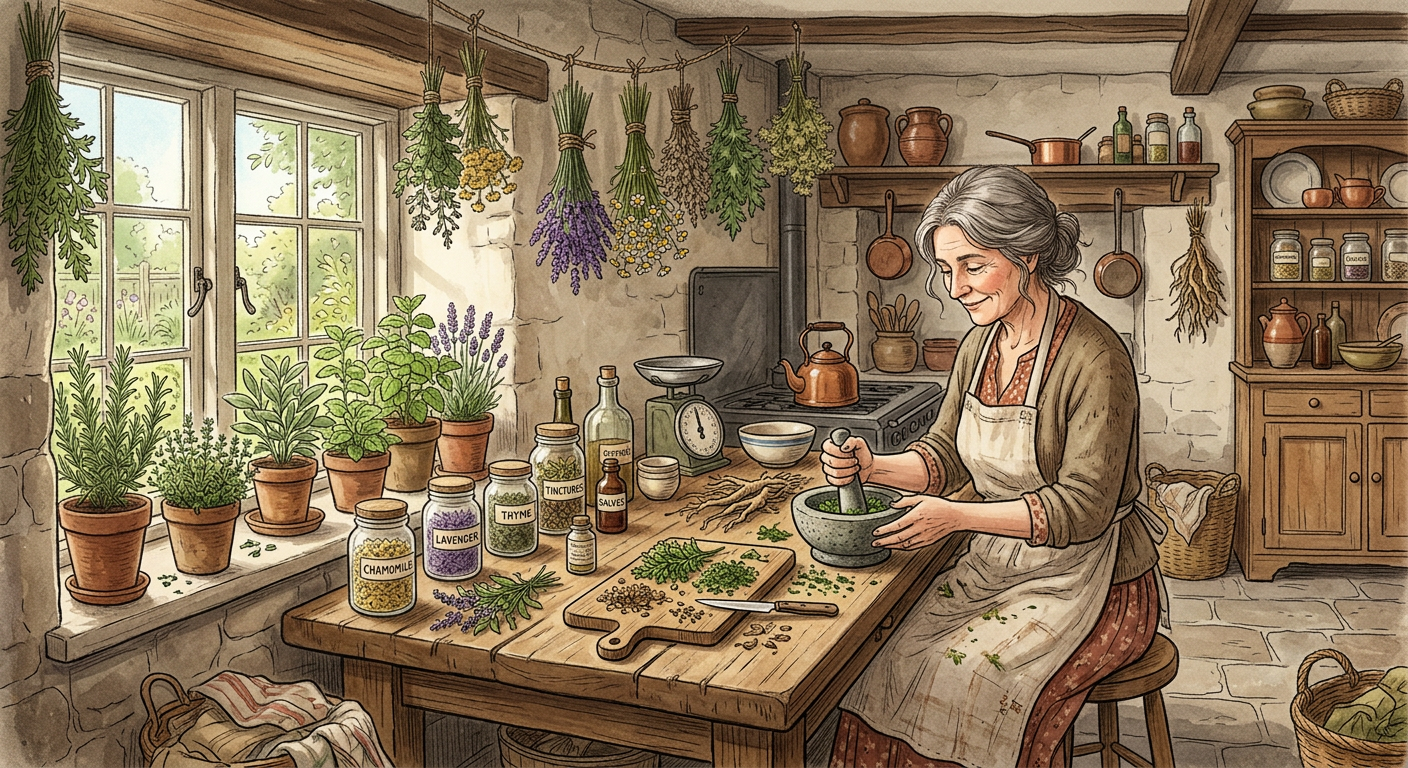
A Little History on the Use of Herbs
A Little History on the Use of Herbs
The relationship between humans and herbs is perhaps the oldest bond in history. Long before the advent of modern laboratories or pharmacies, our ancestors turned to the earth to find relief from pain, heal wounds, and preserve their food. To understand the roots of “The Plot” and our modern gardening practices, we must look back thousands of years to see how these plants shaped human civilization.
The Dawn of Botanical Wisdom
Evidence of herbal use stretches back further than many realize—even before recorded history. Archaeological finds from a 60,000-year-old Neanderthal burial site in northern Iraq (Shanidar IV) revealed pollen from plants like yarrow and ephedra, suggesting that even our early ancestors recognized the significance of these botanical species.
As civilizations began to develop writing, they formalized this knowledge. By 3000 BCE, the Sumerians were etching medicinal plant lists onto clay tablets. In ancient Egypt, the Ebers Papyrus (c. 1550 BCE) served as an extensive medical manual, documenting over 700 herbal formulas. Many herbs they used are still staples in our cabinets today, including garlic for strength, aloe for skin, and coriander for digestion.
The Foundation of Systems: Greece, Rome, and the East
The Greeks and Romans took this foundational knowledge and organized it into systems that would last for over a millennium. Hippocrates, often called the “Father of Western Medicine,” championed the idea that health was a balance of natural forces rather than a result of divine whims.
In the 1st century CE, a Greek physician in the Roman army named Dioscorides wrote De Materia Medica. This monumental work described over 600 plants and 1,000 recipes. It remained the authoritative reference for herbalism in Europe and the Middle East until the 1600s. Meanwhile, in India and China, systems like Ayurveda and Traditional Chinese Medicine were developing their own sophisticated pharmacopeias, utilizing ginger, turmeric, and ginseng to balance the body’s internal energy.
Monks and the Middle Ages
During the Middle Ages in Europe, the torch of herbal knowledge was largely carried by the Church. Monastic gardens became the “pharmacies” of the era. Monks painstakingly copied ancient texts and cultivated “physic gardens,” where they grew sage, mint, and rosemary for both culinary and medicinal use.
This era also saw the rise of the Theory of Humors, where herbs were classified as “hot,” “cold,” “wet,” or “dry” to counteract illnesses. For example, a “cooling” herb like mint might be used to treat a “hot” fever. As trade routes like the Silk Road expanded, exotic spices like cinnamon and ginger arrived from the East, becoming highly prized for their potent healing properties.
The Shift to Modern Science
The Renaissance and the subsequent Industrial Revolution brought a shift in how we view plants. In the 17th century, Nicholas Culpeper famously published The English Physician, making herbal knowledge accessible to the common person in their own language.
However, by the 19th century, scientists began isolating active chemical compounds from plants. For instance, willow bark—used since the time of Hippocrates for pain—was used to derive salicylic acid, leading to the creation of modern aspirin. While this led to the development of powerful pharmaceuticals, it also moved medicine away from the holistic “whole-plant” approach of traditional herbalism.
Conclusion: Returning to Our Roots
Today, we are seeing a resurgence of interest in these ancient ways. Whether it’s planting a “tea garden” in the backyard or using essential oils to clean our homes, we are essentially continuing a conversation that began 60,000 years ago. Understanding the history of herbs reminds us that we aren’t just gardening; we are participating in a timeless tradition of wellness and connection to the earth.
References
-
Herbal Academy. (2018, April 12). A history – How herbalists of the past paved the way for today. https://theherbalacademy.com/blog/herbalism-a-history/
-
Lawrence, J. (2023, January 20). Herbs in history, legend and lore. The Real Dirt. https://ucanr.edu/blog/real-dirt/article/herbs-history-legend-and-lore
-
Medieval History. (2023, January 13). Herbal medicine in the Middle Ages – Healing practices & remedies. https://historymedieval.com/herbal-medicine-in-the-middle-ages/
-
Wikipedia. (n.d.). Medicinal plants. Retrieved May 6, 2026, from https://en.wikipedia.org/wiki/Medicinal_plants
-
Zahra, N., et al. (2024). The evolution of herbal medicine: From traditional practices to scientific validation. ResearchGate. https://www.researchgate.net/publication/390398478_The_Evolution_of_Herbal_Medicine_From_Traditional_Practices_to_Scientific_Validation
Related Posts



Sign up with your email for our monthly newsletter with great information and resources to help make your lives a little easier.